


A gem of Art Nouveau architecture in Barcelona: the Sant Pau complex
One of the architecturally interesting buildings standing nearby Sagrada Família is the old hospital of Santa Creu i Sant Pau. But be careful, it doesn't look like it at all does not resemble hospital buildings as we are used to them in other parts of the world – from the street you would guess it was more of a heroic complex than a facility where people were treated or which contributed to the development of modern medicine in Catalonia.
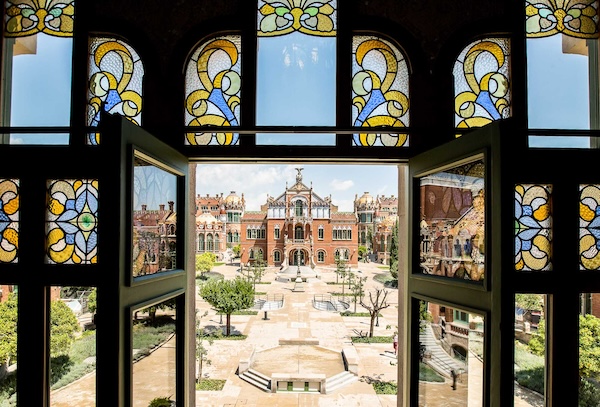
Some of the scenes here will make your eyes water...
But don't be fooled by the exterior – in a complex of several buildings you will find a museum, complemented by a cultural and artistic center. The building itself has also been included in the UNESCO World Heritage List since 1997. This is because it is a prime example of a beautiful Catalan modernism from the drawing board of architect Lluís Domènech i Montaner. (He is also behind the nearby Palau de Música Catalana, the Catalan Palace of Music).
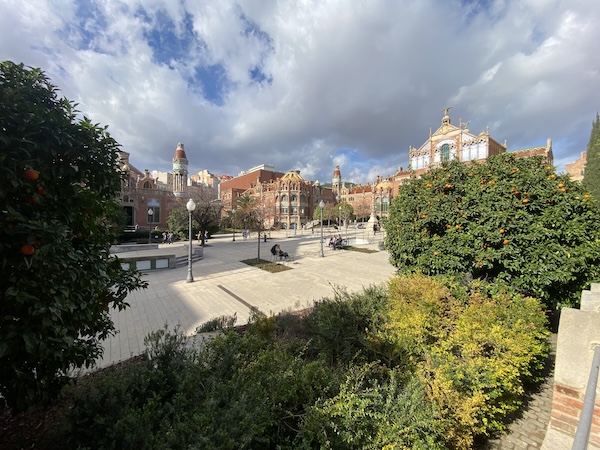
You will find many mandarin trees and other plants in the area.
And although the complex was first opened to the public in 2014, many architecture fans in Barcelona enamel. Most will head to admire Gaudí just to Sagrada Família, visit his Casa Batlló or Park Guell, but they pass by his colleague's construction site without noticing. Don't make that mistake...
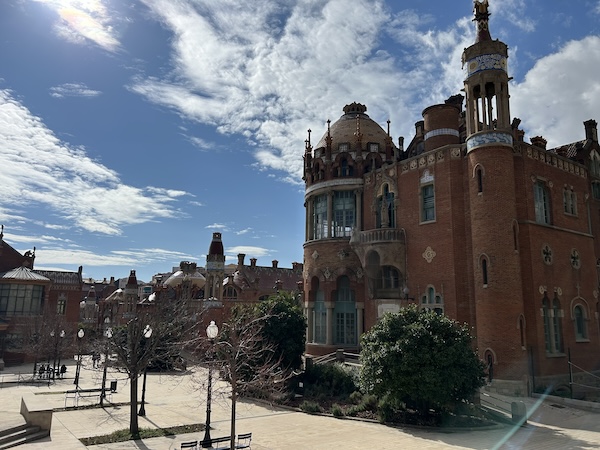
One of the pavilions of the former Sant Pau Hospital
Why you MUST see the Sant Pau complex in Barcelona?
If you love architecture, you like colorful, fairy-tale-looking buildings, you are close to medicine, or you simply want to be captivated by the turbulent development of medicine in the first half of the 1th century, You MUST see this place with your own eyes..
A brief history of the Santa Creu i Sant Pau Hospital
- In the Middle Ages, Barcelona had 6 small hospitals, which later merged into the Hospital de la Santa Creu.
- The new main hospital of Santa Creu then operated for almost 500 years in a Gothic complex in quarter El Raval
- At the end of the 19th century, it was clear that the hospital was no longer meeting modern standards, so it was decided to build a new hospital.
- Lluís Domènech i Montaner was appointed as the main architect and construction began in 1902
- Domènech i Montaner in his project with a total of 48 buildings, but only 27 were eventually built
- The innovative approach was the division into pavilions according to the procedures performed, as well as the emphasis on open spaces, natural light or good air circulation.
- Domènech i Montaner did not live to see its completion and opening in 1930, so the construction was completed by his son, architect Pere Domènech i Roura.
Be careful not to get lost at the entrance...
Upon arriving at the grandiose-looking facade of the main building, it is difficult to appreciate the extent of the entire complex: it is impenetrably hidden behind walls and you can only enter with a valid ticket.

Main entrance to the Sant Pau Recinte Modernista complex in Barcelona
A bit unexpectedly, you can't go straight up the stairs to the area through the main building, but you have to turn right after the entrance gate and go through the side entrance to the area with the shop and cash register.
My tip: Just in front of the ticket office you will find lockers where you can leave your bags or backpacks and go on a tour "lightly".
When purchasing your tickets, you have the option to explore the area on your own or join one of the guided groups. However, guided tours of Sant Pau are only available on weekends.
If you go on your own, I recommend purchasing an audio guide for €4. It is available in English, Spanish, French, German, Italian, Polish, Dutch, Chinese and Japanese.
The entrance ticket to the area is a colored stickerwhich you can attach anywhere visible on your clothing.
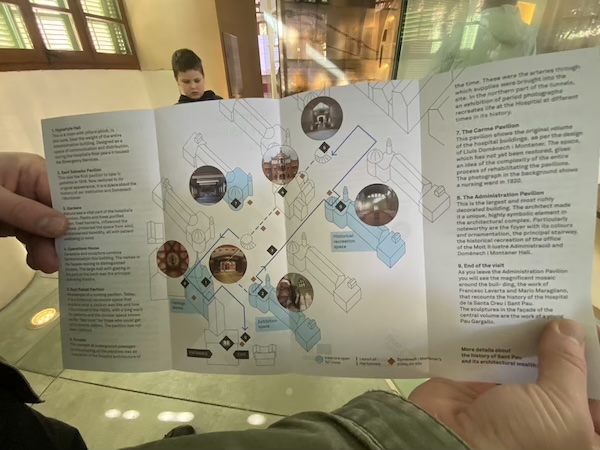
You can see all the stops and buildings of the complex on a clear map
To the ticket automatically you will also receive a map of the area, where you will find a marked tour route. I recommend sticking to it, because you won't miss anything important or, conversely, you won't try to get somewhere you shouldn't go :-)
What will you see here?
Full tour It starts a bit unconventionally underground.. The first stop is the hypostyle temple full of columns that support the main building. Here you will also get to know with an ingenious system of underground passages and tunnels, which run under the local area and made it easier for hospital employees to move between the individual pavilions.
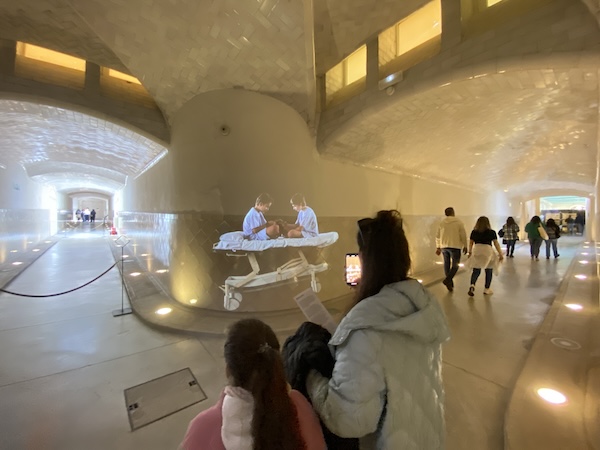
Underground tunnels of the former Sant Pau Hospital
During the tour you will also visit:
- Sant Salvador Pavilion – the second stop is a pavilion dedicated to the history of the hospital and also to its creator, Domènech i Montaner.
- Gardens – the next stop will take you to the spacious outdoor area of the entire complex, where you will find several green areas full of plants and trees. Their significance was therapeutic, as their goal was to maintain clean air, stimulate patients and protect the space from the wind.
- Surgical pavilion – the building combining ceramics and sculptures is not accessible from the inside, but there is also something to see from the outside. Here is the "operating theater" – all major surgical procedures took place here, for example, a team of local doctors performed the first ever heart transplant in Spain.
- Sant Rafael Pavilion – the nursing pavilion, which has not been renovated, will introduce you to how recovering patients were cared for in the past and what methods and tools were used for this.
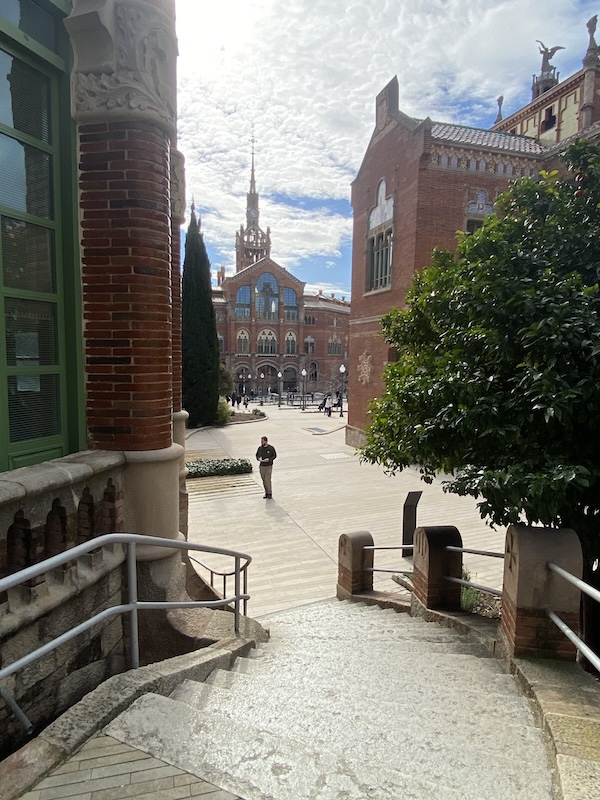
The entrances to the pavilions are elevated and accessible by stairs.
You'll see the best in the end: A richly decorated office building with a beautiful foyer full of ornaments, decorations and a ceiling made of pink tiles. Don't forget to run up to the first floor and admire the view from the windows of the nearby Sagrada...

Decorated administrative building of the former Sant Pau Hospital
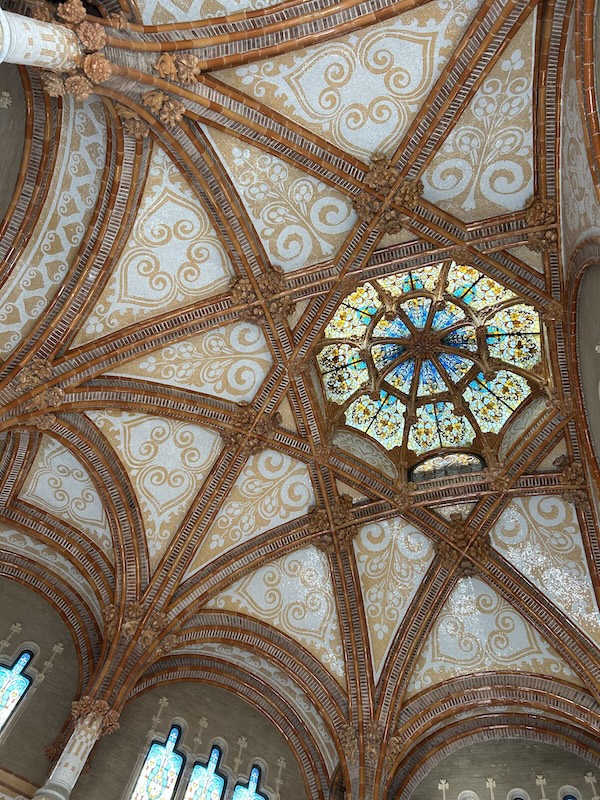
Tilt your head back and look at the beautiful ceilings...
How to get here?
To the museum building Recinte Modernista de Sant Pau you can get there by metro (line L5, Sant Pau stop | Dos de Maig), however, I recommend combining the walk here with a visit to another modernist gem – the Sagrada Família.
Od Sagrada Família leads to the Sant Pau complex Gaudí Avenue, which is a beautiful pedestrian promenade lined with trees, shops and lots of restaurants.

Aerial view showing the unconventional connection between Sant Pau and Sagrada Família, Photograph Robert Ramos
By normal walking you can get from Sagrada to the former hospital in 15 minutes.
Also notice the beautiful lamps along the way., created by Pere Falqués, the city's chief architect at the time. It is also interesting to note that all the lamps here were originally at the crossroads Passeig de Gràcia and Avinguda de Diagonal, but were removed in 1957 because they began to obstruct the increasing traffic. For many years they lay in a municipal warehouse and were only installed on Avinguda de Gaudí in 1985, along with several fountains and statues.
But the entire Avinguda de Gaudí is interesting because it stands out completely from the rest of the urban development. While all the blocks around it are in a regular grid, the streets connecting Sant Pau and Sagrada Família It creates a diagonal that cuts through several of the local "superblocks" like a knife - something you won't see anywhere else in Barcelona. However, the street itself was created after the deaths of both architects, so it wasn't their plan.
Domènech i Montaner had only one intention that he succeeded in constructing: the entrance to the main administrative building is oriented towards Sagrada Família. In this way, he wanted to symbolically connect the axis of health care in "his" hospital with the spiritual renewal in Gaudi's Sagrada Família.

The reconstructed Sant Rafael pavilion shows the period layout of the nursing ward
My tip: Every year in winter, they come to life in the Sant Pau area Christmas lights Els Llums de Sant Pau – go here, for example, with children or soak up the Christmas atmosphere yourself.
A final word...
The complex of buildings of the former Sant Pau Hospital is now open to the public after a demanding and extensive renovation. The public in Barcelona is still learning to discover it, and I believe that sooner or later this place will break into the forefront of the map of architectural gems in Barcelona. There is definitely something to look at here! If you are an architecture fan, you cannot miss this place.
Visit the Sant Pau Modernist complex with a discount!
My tip: Would you like to visit Sant Pau or other modernist monuments and save on entrance fees? Then you might like her tourist card Barcelona Card Modernist, which includes entry to 10 architectural gems...
View card detail >>>
| Name of the monument: | Recinte Modernista de Sant Pau |
| Address: | Sant Antoni Maria Claret, 167 (map) |
| Transportation: |
Metro line L5, stop Sant Pau | Dos de Mai |
| Opening hours: |
From Monday to Saturday from November to March: 9:30 to 17:30 (April to October until 19:00); Sundays and holidays throughout the year: 9:30 a.m. to 15:00 p.m |
| Tickets: |
Regular admission: €18,00 |
| More information: | https://www.santpaubarcelona.org/ |

👇 Don't miss this!
- Discount tourist cards—save on city transportation and get free admission to museums and landmarks, plus great discounts at shops and restaurants.
- Buy tickets online—save money, time, and stress by purchasing admission to attractions from the comfort of your home through the Barcelona Tourist Office’s online store; if you’ve never bought tickets online before, read my detailed guide along with my personal experience on how to do it.
- Find Accommodations—plenty of hotels, hostels, and guesthouses at reasonable prices. You can book immediately and pay after your stay.
- Rent a car—if you don’t want to walk or want to venture further out of Barcelona, try Rental Cars. They’ll deliver the car to the airport, and you won’t have to worry about a thing.
🎟️ Tickets
Sagrada Família tickets, Barcelona Aquarium tickets, Park Güell tickets, FC Barcelona tickets, Picasso Museum tickets – view all tickets >>>
💥 Latest Articles
- For lovers of water and the sea: the Barcelona Aquarium, Marineland Mallorca, Marineland Catalunya, or Water World Park in Lloret de Mar
- Pablo Picasso in Barcelona – How Did the Catalan Metropolis Influence the Life of This World-Renowned Artist?
- Three Kings’ Day in Barcelona – What It’s All About and Where to Watch the Parades
- The Church of Santa Maria del Mar, or the Cathedral of the Sea, as a perfect example of Catalan Gothic architecture
- Souvenirs from Barcelona – what to buy for yourself or your loved ones as a memento of your vacation?
- Bike Rentals in Barcelona – Information on Bike Rental Options and Rental Shops
- Cava + winery tour – where to go for it during your stay in Barcelona?
- Barcelona Metro Map – Digital, Downloadable, and Printable
- Castells, human towers, and gegants, giant figures – unusual Catalan traditions
- The Balearic Islands: Mallorca, Ibiza, Menorca, Formentera – popular tourist destinations about 200 km from Barcelona by sea
- Cable cars in Barcelona – what are the main tourist cable cars, and which one should you choose?
- Free walking tours in Barcelona – guided city tours that won’t cost you a thing
- The Cascada Monumental Fountain – a fountain in a city park designed in part by Gaudí
- Best places for brunch in Barcelona + Best bottomless brunch in Barcelona
- Gaudí’s buildings in Barcelona (map)
- What to Do in Barcelona on Christmas Eve and During the Holiday Season?
- Christmas Garden in Barcelona: Els Llums de Sant Pau
- Taxis in Barcelona: Official Fares for 2026 and Mobile Taxi Apps
- The Luxury Shopping District of Passeig de Gràcia in Barcelona – If You Love Shopping, You Can’t Miss This Street
- Gluten-Free Restaurants in Barcelona – Tips on the Best Places You Must Visit
- La Mercè Celebrations – What Are They All About, and What’s on the Program This Year?
- The Banksy Museum in Barcelona – this unconventional museum featuring works by the famous graffiti artist is definitely worth a visit!
- The Salvador Dalí Museum – take a trip to Figueres, where the famous artist has his museum
- Antoni Gaudí and His Buildings in Barcelona – My List of the Top 9 Must-See Structures
- Vacation in Tarragona – what to see and do in this city?
- Long weekend in Barcelona? – My tips for anyone heading to Barcelona for the first time for a long weekend and wanting to make the most of their vacation.
- Montjuïc Castle (Castell de Montjuïc)—a trip to the castle fortress atop Barcelona’s Montjuïc Hill
- La Roca Village – an outlet village offering international fashion near Barcelona
- What to See, Do, and Experience in Barcelona? (video) – a few videos to inspire your visit to Barcelona
- Spanish food—what must you try in Barcelona? It’s not just paella or tapas...
- Flixbus launches a new bus route from Prague to Barcelona
- Christopher Columbus Monument – a monument to the famous explorer with an unusual view.
- Casa Vicens – Gaudí’s first house in Barcelona, which you’ve definitely never seen before.
- Parking at the Vienna Airport—a detailed article on where to park if you’re flying to Barcelona from Vienna.
- Airport Lounges in 2026—my super-long guide to airport lounges: what they are, what services they offer, and how to get in for free
- Why Not to Buy Flights on Kiwi.com – a summary of my experiences explaining why you should avoid buying flights to Barcelona from resellers
- Austrian Highway Toll Sticker (2026) – my experience with the Austrian highway toll sticker and where to buy it
- Ferries from Barcelona: Barcelona–Mallorca Ferry, Barcelona–Ibiza Ferry, Barcelona–Menorca Ferry
- Internet and Unlimited Data in Switzerland

Who writes this website about Barcelona for you?
 Michal Acler writes the Barcelona guide for you (more about the website and its content). He fell in love with this beautiful Catalan city on his very first visit in 2006 and has been returning here regularly every year ever since. Thanks to this, all the information on this website and on Instagram is up-to-date, verified, and based on his own experiences. If you have a question, a tip, need advice, or have found an error on the website, please send him an email.