


Sparkling wine trip cava in and around Barcelona
If you go to one of the local tapas bars or restaurants in Barcelona, you will almost certainly come across food will be offered i cava. What is this wine, what should you know about it and where to go for the best cava when you are in Barcelona for a few days?
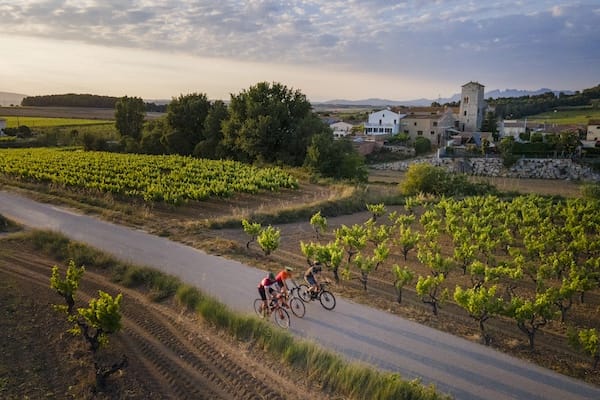
You can walk through the local vineyards or is to ride a bike during a day trip
Content of the article: What is actually cava? - History of wine cava - Map of wine regions - How to choose cava? - Varieties and tastes - Tips for buying - A tour of the vineyards combined with a tasting - Transport to the winery
Experiences, tours and wine tours from Barcelona:
- A visit to a winery combined with a wine tasting cava: Caves Codorníu winery, Caves Freixenet winery
- Cycling trip on an electric bike through the vineyards of the Penedès region
- Guided winery tour, tasting and transport from Barcelona in a Mercedes car (premium experience)
What is actually cava?
Cava is a sparkling wine originating from Spain, which over the years has been included in the list of the most popular drinks intended for export.
Although it fizzes cava also produces in other regions, that's it just Catalonia, which is his cradle and likewise up to 95% of its total production is created here.

The Penedès region has good natural conditions for growing vines
Like champagne, but much more affordable
The story of wine cava started writing as early as 1872 in the Catalan region of Penedès.
Local winemaker Josep Raventós from the Codorníu winery in the town of Sant Sadurní d'Anoia was inspired by the worldwide success of champagne wine and began experimenting with his own production on a similar technological basis.
What is the production of sparkling cava specific?
The specialty of cava and equally of sparkling wine from the Champagne region is the method of preparation, specifically above all multiple fermentation.
The first round and the preparation of the base will take place classically in the tank, but secondary fermentation and subsequent maturation takes place directly in the bottle, in which cava it travels to store shelves or restaurant tables. Compared to standard production, the production process is much longer and more demanding, but thanks to this, a much higher quality wine awaits you at the end.
After some time – and much trial and error – Raventós actually adapted the production process in such a way as to respect the local climatic conditions and use vines from the vineyards around Sant Sadurní d'Anoia.
More than 150 years have passed since that moment, during which it became affordable cava by right it has become a drink that Catalans are justifiably proud of.
Taste the sparkling wine cava in Barcelona
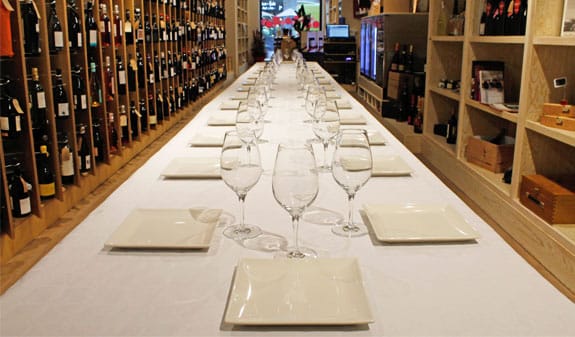
Not everyone wants or can travel for wine from Barcelona to the regions. During your stay in the city, you can book a tasting of local still and sparkling wines cava right in the center in the Di-Vi wine shop.
Map: Barcelona areas where it is produced cava
To the south of Barcelona is the main cava region. Here you will also find the town of Sant Sadurní d'Anoia, where cava was originally created, and home to the largest and most famous wineries such as Codoníu (1), Freixenet (2) and Gramona (3). You can visit all of them during their opening hours and enjoy a glass of well-chilled cava afterwards.

5 main areas between Barcelona and Tarragona, where it is produced cava: Valls d'Anoia Foix, Serra de Mar, Conca del Gaià, Serra de Prades and Pla de Ponent.
The most famous wineries and cava producers in Catalonia
In Catalonia, there are a number of large and small wineries focused specifically on the production of sparkling wine cava. The most famous and popular ones can be found in these cities:
- Sant Sadurní d'Anoia (Quail, Freixenet, gramona)
- Vilafranca del Penedès (Mascaro, Celler de l'Arboç, Cavawith Olivella Galimany)
- Lleida (Raimat, Sauvella)
- Masquefa (Raventos Rosell)
How to choose the right wine type cava?
If you want to have a delicious cava but don't know which one to choose, I'll try to give you a short guide.
The first thing you should look at is the amount of residual sugar. Sparkling wines are made accordingly cava divided into several categories. This chart will tell you more about them.
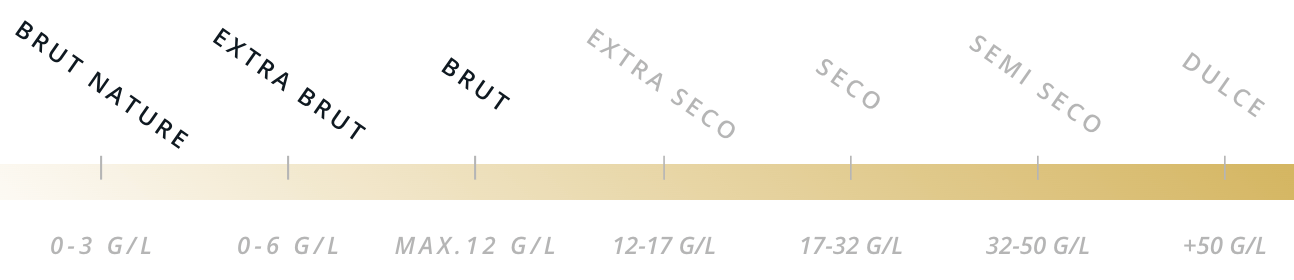
Sparkling wine category cava according to the amount of sugar
The driest type of wine cava je brut de brut a raw nature, medium dry are needed brut a sec, sweeter (and great for desserts) is then cava type semi seco a candy.
When choosing cava, don't forget that the price is similar to any other sparkling wine: the drier the wine, the more you will pay for it.
In addition to the category according to the amount of sugar on the label, you will also find information about the type of cava. This is an indication of the aging time of the given wine:
- Cava de Guarda guarantees at least 9 months of maturation
- Reservation guarantees at least 18 months of maturation
- Gran Reserva guarantees at least 30 months of maturation
- Cava of Qualified Site guarantees an aging of at least 36 months
Get to know the typical varieties and their tastes
Another good guide guide you when choosing a wine cava can help is the type of grapes used to make it. They will determine in advance what taste you can expect from the wine.
In the production of sparkling cava they are the three most commonly used varieties of white wine:
- Macabeo – pleasant freshness, floral aroma and taste of citrus fruits (lemons, grapefruits)
- Xarel·lo – very intense taste, fuller body and richer texture thanks to distinctive fruits such as peaches or pears, often with some herbal touch
- Parellada – a really fresh floral aroma and taste of delicate fruit (e.g. green apples or citrus), often also various nutty notes
In the case of sparkling rosé wines, the red varieties Trepat, Garnacha and Monastrell are used.
Tips for tasting and buying sparkling wine cava
 in the restaurant don't hesitate to ask the staff, to recommend a specific type of wine cava depending on what you put with it
- you don't always have to buy the whole bottle, there is in Barcelona completely normal ordering of wine "by the glass"
- to bring out the best flavor of the wine, it is good to serve it well chilled, a temperature of 6-8 °C is usually recommended.
- if you want to be sure that the sparkling wine is real cava, look for the category label on the bottle (see above) and also black star with four arms on the top or bottom of the cork
Cava trip from Barcelona combined with a tour of vineyards, cellars and wine tasting
If you want to see where cava was created, there is nothing easier than going from Barcelona by train or bus for a day trip to the Penedès region. It was here that history was written (and today the future is being created here) connected with the production of sparkling wine cava.
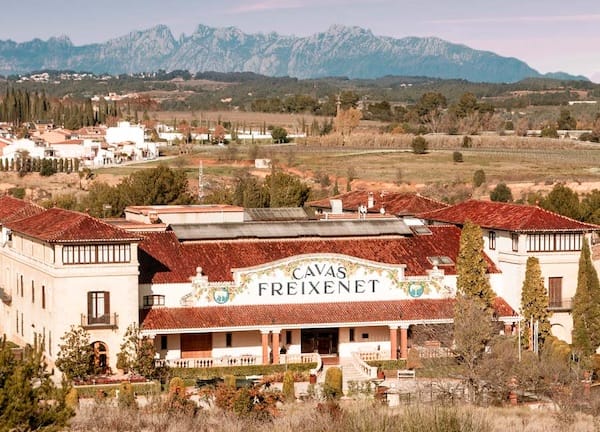
Cavas Freixenet belongs to one of the larger wineries producing traditional sparkling wine cava
A trip to one of the wineries is a great option to enjoy some to take a break from the hustle and bustle of the big city and enjoy the peace of the countryside. All this, of course, over a glass of one of the traditional sparkling wines, or you can taste the latest additions to the winemakers' menu, such as organic, bio or even vegetarian cava.
A visit to a winery
All major wineries their gates are normally open for wine lovers during the classic opening hours.
A clear recommendation if you want to taste the local wines is go to the town of Sant Sadurní d'Anoia. It is considered to be "cava "centre" of Catalonia, you will find over 50 producers of still and sparkling wines here, and above all, the two largest wineries are based here: Codornía and Freixenet.
Caves Codorníu: the place where it was created cava
This winery has belonged to the Raventós family for many generations, without whose ancestors it would be cava probably never came into being.
The winery is located on a huge plot of land dominated by a modernist building signed by the famous architect Puig i Cadafalch (from whom you can recognize in Barcelona Casa Amatller or Casa de les Punxes).
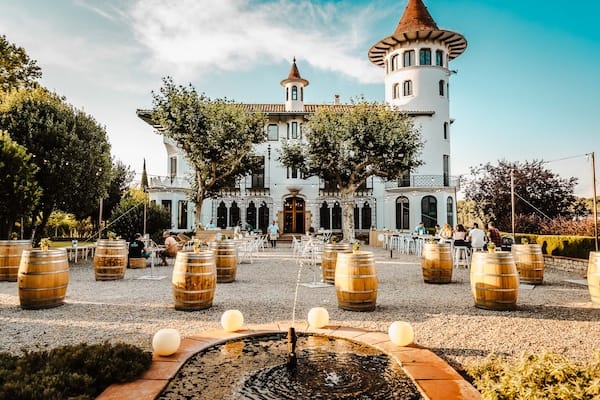
The main building of the Codorníu winery, designed by the famous architect Josep Puig i Cadafalch in 1906 in the spirit Catalan modernism.
As for the tour, there are several circuits to choose from depending on what you are interested in. Of course, they all include a tasting. You can find a complete overview at their website, or you can look at the offer Barcelona Turisme:
- Iconic Tour – the main sightseeing route that takes you through the cellars and the history of the almost 500-year-old winery, a tasting of 3 quality wines and a small aperitif, 105 minutes
- Discovery Tours – shortened version of the main sightseeing route, tasting of 2 wines, 75 minutes
More information about the winery tour + reservation >>>
Cavawith Freixenet: a family winery with a long tradition
The second tip for a winery from the town of Sant Sadurní d'Anoia is clearly Freixenet.
Similar to Codorní, it is a family business owned by several generations of descendants of the original founders.
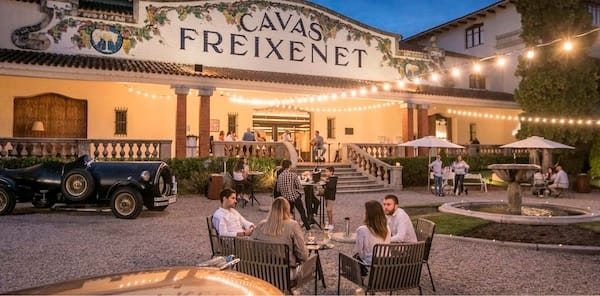
Viticulture Cavas Freixenet has a relaxed, family atmosphere
The Freixenet winery, whose wines are guaranteed to be recognized by the iconic dark bottle, focuses mainly on quality, traditional flavors, innovation, and sustainability is a big topic for them in recent years.
An undeniable advantage Cavawith Freixenet is its location: it is literally a few steps from Sant Sadurní train station, which you can reach from Barcelona in 45 minutes (Caves Codorníu is considerably further, it is located a little outside the city).
As part of the trip, you can visit the winery, watch a short video about its history, look into the cellars and taste 2 samples of local sparkling wine.
More information about the winery tour + reservation >>>
Premium experience: Small group wine tour
Would you like to take a trip to the local Penedès wine region during your stay in Barcelona? You can either go here on your own (see below), or use one of the travel packages, such as Wine & Cava Premium Experience, which includes:
- transport from Barcelona Mercedes SUV
- personal guide
- guided tour of two wineries
- tasting of 4 classic and 4 sparkling wines together with tapas
- a jeep ride through the vineyards with a local winemaker

How to get to the wineries in the Penedès region from Barcelona?
If you want to go from Barcelona to the local wineries and explore the wine type cava, you have several options to get there.
Transport by train
The easiest way to go on a winery tour from Barcelona is by train.
Renfe L4 commuter trains depart from the main Catalan Square or from the station Barcelona Sants westbound towards Alt Penedès from Monday to Friday (every 30 minutes) or at the weekend (every 60 minutes).
Trains run in the direction of Vilafranca del Penedès / Sant Vicenç de Calders and your destination station will be the Sant Sadurní d'Anoia stop. The journey takes about 45 minutes.
If you want to go to the Freixenet winery, it's literally a 2-minute walk from the train station. The Cordoníu winery is about 30 minutes' walk from the station, so it is better to use a local taxi (phone 938 910 428).
Transportation by bus
If you don't want a train, you can also take the Hillsa bus from Barcelona to Sant Sadurní (time tables). You can get on it at any stop in Barcelona, and in the same way at your destination you can choose the stop that will be closest to "your" winery.
The bus runs in both directions approximately every hour and the last connection to Barcelona from Sant Sadurní leaves at half past eight in the evening.
They pay for the bus classic public transport tickets (3 zones).
Transportation by car
If you don't want to depend on public transport and want to explore more of the local wineries, I recommend it rent a car in Barcelona. Thanks to it, you can get where you need to go - some small wineries are not served by public transport at all.
From Barcelona, just take the AP-7 or AP-2 road and then exit at the sign for exit 27 (Sant Sadurní d'Anoia). The distance from Barcelona is about 40 km.

👇 Don't miss this!
- Discount tourist cards—save on city transportation and get free admission to museums and landmarks, plus great discounts at shops and restaurants.
- Buy tickets online—save money, time, and stress by purchasing admission to attractions from the comfort of your home through the Barcelona Tourist Office’s online store; if you’ve never bought tickets online before, read my detailed guide along with my personal experience on how to do it.
- Find Accommodations—plenty of hotels, hostels, and guesthouses at reasonable prices. You can book immediately and pay after your stay.
- Rent a car—if you don’t want to walk or want to venture further out of Barcelona, try Rental Cars. They’ll deliver the car to the airport, and you won’t have to worry about a thing.
🎟️ Tickets
Sagrada Família tickets, Barcelona Aquarium tickets, Park Güell tickets, FC Barcelona tickets, Picasso Museum tickets – view all tickets >>>
💥 Latest Articles
- For lovers of water and the sea: the Barcelona Aquarium, Marineland Mallorca, Marineland Catalunya, or Water World Park in Lloret de Mar
- Pablo Picasso in Barcelona – How Did the Catalan Metropolis Influence the Life of This World-Renowned Artist?
- Three Kings’ Day in Barcelona – What It’s All About and Where to Watch the Parades
- The Church of Santa Maria del Mar, or the Cathedral of the Sea, as a perfect example of Catalan Gothic architecture
- Souvenirs from Barcelona – what to buy for yourself or your loved ones as a memento of your vacation?
- Bike Rentals in Barcelona – Information on Bike Rental Options and Rental Shops
- Cava + winery tour – where to go for it during your stay in Barcelona?
- Barcelona Metro Map – Digital, Downloadable, and Printable
- Castells, human towers, and gegants, giant figures – unusual Catalan traditions
- The Balearic Islands: Mallorca, Ibiza, Menorca, Formentera – popular tourist destinations about 200 km from Barcelona by sea
- Cable cars in Barcelona – what are the main tourist cable cars, and which one should you choose?
- Free walking tours in Barcelona – guided city tours that won’t cost you a thing
- The Cascada Monumental Fountain – a fountain in a city park designed in part by Gaudí
- Best places for brunch in Barcelona + Best bottomless brunch in Barcelona
- Gaudí’s buildings in Barcelona (map)
- What to Do in Barcelona on Christmas Eve and During the Holiday Season?
- Christmas Garden in Barcelona: Els Llums de Sant Pau
- Taxis in Barcelona: Official Fares for 2026 and Mobile Taxi Apps
- The Luxury Shopping District of Passeig de Gràcia in Barcelona – If You Love Shopping, You Can’t Miss This Street
- Gluten-Free Restaurants in Barcelona – Tips on the Best Places You Must Visit
- La Mercè Celebrations – What Are They All About, and What’s on the Program This Year?
- The Banksy Museum in Barcelona – this unconventional museum featuring works by the famous graffiti artist is definitely worth a visit!
- The Salvador Dalí Museum – take a trip to Figueres, where the famous artist has his museum
- Antoni Gaudí and His Buildings in Barcelona – My List of the Top 9 Must-See Structures
- Vacation in Tarragona – what to see and do in this city?
- Long weekend in Barcelona? – My tips for anyone heading to Barcelona for the first time for a long weekend and wanting to make the most of their vacation.
- Montjuïc Castle (Castell de Montjuïc)—a trip to the castle fortress atop Barcelona’s Montjuïc Hill
- La Roca Village – an outlet village offering international fashion near Barcelona
- What to See, Do, and Experience in Barcelona? (video) – a few videos to inspire your visit to Barcelona
- Spanish food—what must you try in Barcelona? It’s not just paella or tapas...
- Flixbus launches a new bus route from Prague to Barcelona
- Christopher Columbus Monument – a monument to the famous explorer with an unusual view.
- Casa Vicens – Gaudí’s first house in Barcelona, which you’ve definitely never seen before.
- Parking at the Vienna Airport—a detailed article on where to park if you’re flying to Barcelona from Vienna.
- Airport Lounges in 2026—my super-long guide to airport lounges: what they are, what services they offer, and how to get in for free
- Why Not to Buy Flights on Kiwi.com – a summary of my experiences explaining why you should avoid buying flights to Barcelona from resellers
- Austrian Highway Toll Sticker (2026) – my experience with the Austrian highway toll sticker and where to buy it
- Ferries from Barcelona: Barcelona–Mallorca Ferry, Barcelona–Ibiza Ferry, Barcelona–Menorca Ferry
- Internet and Unlimited Data in Switzerland

Who writes this website about Barcelona for you?
 Michal Acler writes the Barcelona guide for you (more about the website and its content). He fell in love with this beautiful Catalan city on his very first visit in 2006 and has been returning here regularly every year ever since. Thanks to this, all the information on this website and on Instagram is up-to-date, verified, and based on his own experiences. If you have a question, a tip, need advice, or have found an error on the website, please send him an email.