


Antoni Gaudí and his buildings in Barcelona: 9 architectural gems you must know!
Barcelona was most influenced and at the same time globally famous by two events - the hosting of the Olympic Games in 1992 and a hundred years before that, the work of the architect Antoni Gaudí. His original style, working with a number of artistic inspirations, combining the beauty and playfulness of nature with the austerity and precision of geometry, and on top of creating his own original creations, literally transformed Barcelona and imprinted its unique charm on it.
Get inspired by my overview of the best Gaudi buildings you can find in Barcelona a her surroundings.
9 of the most famous buildings under which Gaudi is signed
- Gaudi's pavilions
- Casa Vicens
- Palace Güell
- Colony Güell
- Bellesguard Tower
- Casa Batlló
- Casa Milà
- Park Güell
- Temple Sagrada Família
Tip: You can also find all of Gaudi's buildings on the clear map >
1. Gaudi's Finca Güell pavilions
Complex Pavellons de la Finca Güell (Güell's Pavilions or Gaudi's Pavilions) originally built as a summer residence for industrialist Eusebi Güell Gaudí's teacher Joan Martorell. He invited Gaudí to help with its completion, which gave the budding architect his first real opportunity to demonstrate his skill and genius. He threw himself into work and between 1883 and 1887 built stables, a riding stable, a viewing terrace, a magnificent staircase, fencing, a gatehouse including gates, and partly also a garden with a pair of fountains.
 The Finca Güell complex under which the genius Gaudí is signed
It was the wrought-iron grille of the northern entrance gate in the form of the dragon Ládón guarding a tree with golden apples in the garden of the Hesperides, created by artistic blacksmith Joan Oñós, that made the entire building most famous.
However, due to the reconstruction of the area into the Royal Palace of Pedralbes in 1919, most of Gaudí's work was not preserved - fortunately, with the exception of the stables, riding stables, fencing and the "Dragon Gate", the beauty of which you can still admire today.

Detail of the dragon at the entrance gate to Güell's pavilions
Where can you find the pavilions?
Güell's pavilions are now part of the protected campus of the University of Catalonia and can be found at Avinguda de Pedralbes 7 (map).
How to get here?
Get off at Palau Reial metro station (line L3) or Palau Reial trams (lines T1, T2 and T3) and then walk for about 10 minutes. A bus also goes directly to the pavilions (stops Palau Reial and Av Pedralbes - Pg Manuel Girona).
Visit Gaudí's monument with a discount!
My tip: Would you like to visit the buildings from this list and save a few euros? Then you might like her tourist card Barcelona Card Modernist, which includes entry to 10 architectural gems...
View card detail >>>
2. Casa Vicens
The "Red House" with its chessboard-like facade was designed by Gaudí for ceramics merchant Manuel Vicenzo as one of his first commissions. The house was built between 1883 and 1889.

Facade Casa Vicens she is seriously photogenic!
Today it is a building Casa Vicens significant for its architectural concept, which clearly demonstrates oriental and Moorish influences in Catalan modernism. The facade of the building is richly decorated with ceramic elements and colorful mosaics.
 Colorful Casa Vicens it will definitely impress you with its facade
In 2005 it was Casa Vicens declared a UNESCO monument and opened to the public as a museum in 2017. Here, visitors can view various exhibits that show the history of the building as well as Gaudí's work as an architect and designer.
More about Casa Vicens in a separate article
Where to find Casa Vicens?
Casa Vicens you will see on Carrer de les Carolines in the Barcelona district Gràcia (map).
How to get here?
Finish it by metro line L3 to Fontana or Lesseps station and then on foot.
Opening hours
November - March: Monday: 10:00 - 15:00; Tuesday - Sunday: 10:00 - 19:00
April - October: every day 10:00 - 20:00
December 31 open: 10:00 a.m. - 17:00 p.m
Closed on December 25 and January 6
Admission
General admission: €18, adults over 65, students 12-25: €16, children under 11: free, find tickets >>>
3. Güell Palace
Gaudí's first major construction was a new residence for Eusebi Güell – a palace that followed the original residence and significantly expanded it. Construction began in 1886 after delays associated with the rejection of the project by the city architect. In 1888, the Güell family moved into the palace, and for the next two years, the finishing works took place.

View of Güell Palace from Carrer Nou de la Rambla
In 1910, the family changed their address again, this time to a new house in Park Güell.
The Güell Palace is a finished art exhibition. Although Gaudí still learned a little here and tried out some of his typical elements in practice (such as parabolic arches or sculpturally decorated chimneys), the beauty, functionality and diversity of the building will completely captivate you. Just look at the entrance portals with decorative grilles, the spiral ramp for carriages, the altar, the organ or the ingenious ventilation and lighting system. What a detail, what a masterpiece - after all, a number of prominent artists also participated in the interior decoration.

The Güell Palace with its interesting "mushroom" roof can be found a short distance from the familiar one La Rambla street
What many people do not know is that in 1888 the Güell Palace served as one of the exhibition pavilions of the Barcelona World Exhibition. And this despite the fact that at that time it was already inhabited by the factory owner Güell and his family.
 The Güell Palace has rich interiors that are worth seeing
Where it is
Güell Palace is located on Carrer Nou de la Rambla, literally just a few steps from La Rambla.
How to get here
Get off at Liceu metro station (line L3), head towards the sea until you come across Carrer Nou de la Rambla on your right.
Opening hours
April to September: 10 a.m. to 20 p.m. (except Mondays outside holidays)
October to March: 10 a.m. to 17.30:25 p.m. (except the last week of January, Mondays, 12/26, 12/1, 1/6 and 1/XNUMX)
Entrance fees
Standard: €12 (basic price), €5 (children from 10 to 17), €0 (children under 9, disabled)
Free: first Sunday of the month, online reservation required, find tickets >>>
4. Colony Güell and Gaudí's crypt
A little-known Gaudi building is Colony Güell, also sometimes known as Gaudí's Colony Güell (Colonia Güell). The famous architect created it again for his patron, the factory owner Eusebi Güell. He had his own textile mill in the village of Santa Coloma de Cervelló, and in order to prevent social unrest, he decided to build a modern infrastructure around it for his employees, shops, a school or even a hospital.

Entrance to the crypt in Colony Güell
Gaudí's main project within the colony was the church, which, however, could not be completed due to the death of the factory owner Güell. Gaudí's crypt remained his memento – and the most famous building of the entire colony. It was intended to serve the inhabitants of the colony, and even though it was never completed, the architect's dreamy handwriting is more than evident from it: the use of curved surfaces, inclined columns, organic shapes and other unique and unseen forms.

The main crypt in Colony Güell
In the crypt, you can see the use of technology in some places (see, for example, the window arches from the outside). trencadis, that is, the application of colored mosaics on surfaces with the aim of creating a visually interesting and attractive surface treatment.
Colony Güell is now open to the public as a tourist attraction and its crypt is one of the main examples of modernist architecture in Barcelona. If you like Gaudí, you will definitely like this work. It proves how great visionaries Gaudí and his patron Güell were. It's just a shame that more of the colony didn't survive.

Aerial view of the preserved remains of the Güell colony
Where it is
To visit Colònia Güell, head to Santa Coloma de Cervelló in the Baix Llobregat administrative district west of Barcelona (map).
How to get here
Literally just a few steps from Colònia Güell is the train station of the same name (FGC lines S3, S4, S8 and S9, Colonia Güell stop)
Opening hours
Open all year, weekdays 10:00-17:00, Saturdays, Sundays and public holidays 10:00-15:00
Entrance fees
€10,00 (basic price), €7,5 reduced admission (seniors over 65, students), find tickets >>>
5. Torre Bellesguard
Another Gaudí monument that you must see in Barcelona is the castle Bellesguard Tower (also Torre Figueres whether Casa Figueres, in Czech "Beautiful View") in the Sarrià-Sant Gervasise district. When designing it, Gaudí was inspired by the castle, which had been falling apart since the Middle Ages. Gaudí's protracted search for his own artistic style led to delays in construction, exceeding the financial budget and finally his departure from the work in progress in 1909.
 Gaudi's "medieval castle" or Torre Bellesguard
In the modernist interior you will see Gaudí's typical ceramic mosaics and use of natural elements, many windows (from the outside evoking dragon's eyes), often with stained glass, beautiful chandeliers or ornate railings. The own corner tower "Torre Bellesguard" ends with the Catalan flag in the form of a cross flower with a red and yellow mosaic.
 The richly decorated staircase offers a lot of details, just like the entire building
Since 2013, the general public has been able to see the house, including the adjacent gardens. Thanks to its neo-Gothic form, a medieval atmosphere breathes on you here.

Interior of Torre Bellesguard
Where it is
Torre Bellesguard turns off in the area off Carrer de Bellesguard on the slope of Mount Collserola (Turó de Mont, 440 m) above Barcelona (map).
How to get here
The best way to arrive is by bus: Bellesguard stop (line 196) or Tibidabo stop (lines V13 and V15).
Opening hours
All year round, every day except Monday from 10 a.m. to 15 p.m
Entrance fees
€9 (basic price), €7,2 (seniors over 65 and students under 18), €0 (children under 8, disabled), find tickets >>>
6. Casa Batlló
Haunted palace or alien residence? Nowhere, an art nouveau building Casa Batlló is just another of Antoni Gaudí's amazing creations. This time it is a reconstruction of the original building from 1877, which the Catalan genius carried out on the order of the industrialist Josep Batlló i Casanovas 30 years later.

House of the Dragon, or Casa Batlló
Interesting fact: Let on Casa You can look at Batlló from any side and from any angle, it will never have the same effect - Gaudí's playfulness simply cannot be denied.
More information about Casa Batlló in a separate article

View of casa Batlló from the main street
Where it is
Casa Batlló captivates passersby on shopping street Passeig de Gràcia, roughly 700 m from Plaça de Catalunya.
How to get here
Entrances to the Passeig de metro transfer station Gràcia (purple line L2, green L3 a blue L5) are all around.
Opening hours
Year-round, daily from 9 a.m. to 20 p.m
Entrance fees
€35 (basic price, depends on the type of tour you choose, online purchase), find tickets >>>
7. Casa Milà
Building construction Casa Milà (also called La Pedrera, meaning "quarry" in Czech) for a millionaire named Pere Milà i Camps began in 1906. The incredibly diverse, rambling, even flamboyant architecture of the building with an almost endless amount of artistic "showpieces", which swallowed more and more finances, fueled constant disputes between Gaudí and Milová wife Rosaria Segimon i Artells. Because of this, the contract ended in 1910 and Gaudí left.
 View of Casa Milà since her entry
The work in progress was completed only at the turn of the 80s and 90s of the 20th century. Thanks to this, today you can Casa Milà as part of the tour, visit a pair of apartments with original furniture and an articulated terrace on the roof. There is also a museum with models of Gaudí's work, a cafe and spaces for organizing cultural events.
 Decorated chimneys on the Gaudi roof Casa Milà
More information about Casa Milà in a separate article
Where it is
Casa Milà it stands on the corner of Paseig de Gracia and Carrer de Provença near Avinguda Diagonal.
How to get here
Take the metro to Diagonal station (green line L3 a blue L5), from which it is only a few steps to the building. You can also use the bus (lines 6, 7, 22, 24, 33, 34, H8, H10, V15, V17).
Opening hours
All year round, Friday to Saturday from 9 a.m. (closing time depends on the season)
Entrance fees
€25 (basic price, online purchase), €19 (seniors over 65), €12,5 (seniors and children from 7 to 12), €0 (children under 6), find tickets >>>
8. Park Guell
It was supposed to be a grandiose garden city, but only two of the planned sixty villas found their buyer - they were the builders of Park Güell and Gaudí themselves. Both of them lived in them until their deaths (1918 and 1926 respectively), and this could bring the story of the ambitious project to an inglorious end. Fortunately, the area was later bought by the city of Barcelona, made available to the general public as Park Güell, and a Gaudí museum was established in one of the villas.

Park Güell is one of the most visited Barcelona monuments
The vast park on the slopes of the Turó del Carmel hill can be admired by tourists as well.
On an area of almost 18 hectares, it is literally overflowing with quirky building accessories, full of expressions of Gaudí's famous playfulness and surprising with elaborate details. As always, they are primarily inspired by nature – here, as if lava streams are rolling, elsewhere, shapes are clustered into imitations of trees, and Gaudí's beloved mosaics are also present.

The dominant feature of Park Güell is a huge terrace with a wonderfully decorated railing, under which the Hall of a Hundred Columns is hidden, evoking a stalactite cave. You can reach it by taking the stairs directly from the main entrance to the area. The entrance to the natural kingdom of fantasy is guarded by two "gingerbread houses", again buildings so characteristic of Gaudí's work.
More information about Park Güell in a separate article
Where it is
Park Güell covers an area of approximately 20 hectares on Carrer d'Olot near Travessera de Dalt Boulevard.
How to get here
The public transport bus goes directly to the park (line 116, Park Güell stop). The nearest metro stations (Lesseps and Vallcarca) are on the green line L3.
Opening hours
January 9.30:17.30 a.m.–XNUMX:XNUMX p.m
February: 9.30:17.30 a.m.–9.30:18 p.m., XNUMX:XNUMX a.m.–XNUMX p.m. (weekends)
March: 9.30:18 a.m.–XNUMX p.m
April to June: 9.30:19.30 a.m.–XNUMX:XNUMX p.m
July and August: 9–19.30 h
September and October: 9.30:19.30 a.m.–XNUMX:XNUMX p.m
November and December 9.30:17.30 a.m.–XNUMX:XNUMX p.m
Entrance fees
€10 (basic price), €7 (seniors and children from 7 to 12 years), €0 (children under 6, disabled), find tickets >>>
9. Temple Sagrada Família
Temple Sagrada Família (Czech: Temple of Reconciliation, dedicated to the Holy Family), this is undoubtedly Gaudí's most important and most famous work. At the same time, it all started quite inconspicuously – the Order of St. Josef had planned a simple, "ordinary" church, but the deeply religious Gaudí embarked on the realization of a truly "divine" building.

This is it, the Sagrada Famlia in Barcelona
He set himself the goal of creating a cathedral that, with its beauty and monumentality, would encourage a return to the values of the Roman Catholic Church. That is also why it has always been built only from donations, and that is why it literally overflows with Christian symbolism. This is evidenced by the three magnificent Nativity, Passion and Resurrection facades. And the eighteen towers, for example, represent the 12 apostles, 4 evangelists, the Virgin Mary and – of course, the tallest one, which is supposed to reach a height of 170 meters – Jesus Christ.
Sagrada Família has been built since 1882 until today.
 Interior of the temple Sagrada Familia is breathtaking
After Gaudí's death (1926), activity at the construction site died down for a few years (1935 to 1952), as it seemed very difficult to continue construction in the original spirit. In the end, however, the method of implementation and the means for it were found, and so on November 7, 2010, a solemn moment could occur: in connection with the roofing of the tabernacle, it was consecrated by Pope Benedict XVI.
And if everything goes well, the construction of the cathedral will be completed on the centenary of Antonio Gaudí's death, i.e. in 2026.
Although Gaudí did not live to see the completion of the building, if he were among us, he would most likely have "painted" the outside of his house just like his other buildings, which are famous for their color...
More information about Sagrada Familia in a separate article
Where it is
Sagrada Família is located between Plaça de Gaudí and Plaça de la Sagrada Família and between Carrer de Mallorca, Carrer de Sardenya, carrer de la Marina and Carrer de Provença.
How to get here
Get off at the metro station Sagrada Família (lines L2 and L5).
Opening hours
November to February: 9 a.m. to 18 p.m. (except Sundays), 10.30 a.m. to 18 p.m. (Sundays)
March and October: 9 a.m.–19 p.m. (except Sundays), 10.30 a.m.–19 p.m. (Sundays)
April to September: 9 a.m. to 20 p.m. (except Sundays), 10.30 a.m. to 20 p.m. (Sundays)
Entrance fees
Without towers: €26 (basic price), €24 (students and under 30 years of age), €21 (seniors), €0 (children under 11, disabled)
With towers: €36 (base price), €34 (students and under 30), €28 (seniors), €10 (disabled), €0 (children under 11)
Visit Gaudí's monument with a discount!
View card detail >>>
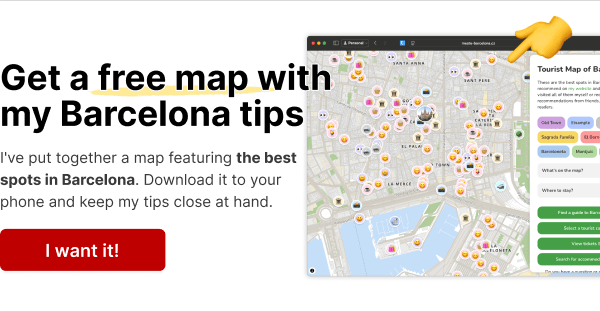
Map of all Gaudí buildings
If you would like to see all of Gaudí's buildings with your own eyes, download mine map with all buildings described in this article.


👇 Don't miss this!
- Discount tourist cards—save on city transportation and get free admission to museums and landmarks, plus great discounts at shops and restaurants.
- Buy tickets online—save money, time, and stress by purchasing admission to attractions from the comfort of your home through the Barcelona Tourist Office’s online store; if you’ve never bought tickets online before, read my detailed guide along with my personal experience on how to do it.
- Find Accommodations—plenty of hotels, hostels, and guesthouses at reasonable prices. You can book immediately and pay after your stay.
- Rent a car—if you don’t want to walk or want to venture further out of Barcelona, try Rental Cars. They’ll deliver the car to the airport, and you won’t have to worry about a thing.
🎟️ Tickets
Sagrada Família tickets, Barcelona Aquarium tickets, Park Güell tickets, FC Barcelona tickets, Picasso Museum tickets – view all tickets >>>
💥 Latest Articles
- For lovers of water and the sea: the Barcelona Aquarium, Marineland Mallorca, Marineland Catalunya, or Water World Park in Lloret de Mar
- Pablo Picasso in Barcelona – How Did the Catalan Metropolis Influence the Life of This World-Renowned Artist?
- Three Kings’ Day in Barcelona – What It’s All About and Where to Watch the Parades
- The Church of Santa Maria del Mar, or the Cathedral of the Sea, as a perfect example of Catalan Gothic architecture
- Souvenirs from Barcelona – what to buy for yourself or your loved ones as a memento of your vacation?
- Bike Rentals in Barcelona – Information on Bike Rental Options and Rental Shops
- Cava + winery tour – where to go for it during your stay in Barcelona?
- Barcelona Metro Map – Digital, Downloadable, and Printable
- Castells, human towers, and gegants, giant figures – unusual Catalan traditions
- The Balearic Islands: Mallorca, Ibiza, Menorca, Formentera – popular tourist destinations about 200 km from Barcelona by sea
- Cable cars in Barcelona – what are the main tourist cable cars, and which one should you choose?
- Free walking tours in Barcelona – guided city tours that won’t cost you a thing
- The Cascada Monumental Fountain – a fountain in a city park designed in part by Gaudí
- Best places for brunch in Barcelona + Best bottomless brunch in Barcelona
- Gaudí’s buildings in Barcelona (map)
- What to Do in Barcelona on Christmas Eve and During the Holiday Season?
- Christmas Garden in Barcelona: Els Llums de Sant Pau
- Taxis in Barcelona: Official Fares for 2026 and Mobile Taxi Apps
- The Luxury Shopping District of Passeig de Gràcia in Barcelona – If You Love Shopping, You Can’t Miss This Street
- Gluten-Free Restaurants in Barcelona – Tips on the Best Places You Must Visit
- La Mercè Celebrations – What Are They All About, and What’s on the Program This Year?
- The Banksy Museum in Barcelona – this unconventional museum featuring works by the famous graffiti artist is definitely worth a visit!
- The Salvador Dalí Museum – take a trip to Figueres, where the famous artist has his museum
- Antoni Gaudí and His Buildings in Barcelona – My List of the Top 9 Must-See Structures
- Vacation in Tarragona – what to see and do in this city?
- Long weekend in Barcelona? – My tips for anyone heading to Barcelona for the first time for a long weekend and wanting to make the most of their vacation.
- Montjuïc Castle (Castell de Montjuïc)—a trip to the castle fortress atop Barcelona’s Montjuïc Hill
- La Roca Village – an outlet village offering international fashion near Barcelona
- What to See, Do, and Experience in Barcelona? (video) – a few videos to inspire your visit to Barcelona
- Spanish food—what must you try in Barcelona? It’s not just paella or tapas...
- Flixbus launches a new bus route from Prague to Barcelona
- Christopher Columbus Monument – a monument to the famous explorer with an unusual view.
- Casa Vicens – Gaudí’s first house in Barcelona, which you’ve definitely never seen before.
- Parking at the Vienna Airport—a detailed article on where to park if you’re flying to Barcelona from Vienna.
- Airport Lounges in 2026—my super-long guide to airport lounges: what they are, what services they offer, and how to get in for free
- Why Not to Buy Flights on Kiwi.com – a summary of my experiences explaining why you should avoid buying flights to Barcelona from resellers
- Austrian Highway Toll Sticker (2026) – my experience with the Austrian highway toll sticker and where to buy it
- Ferries from Barcelona: Barcelona–Mallorca Ferry, Barcelona–Ibiza Ferry, Barcelona–Menorca Ferry
- Internet and Unlimited Data in Switzerland

Who writes this website about Barcelona for you?
 Michal Acler writes the Barcelona guide for you (more about the website and its content). He fell in love with this beautiful Catalan city on his very first visit in 2006 and has been returning here regularly every year ever since. Thanks to this, all the information on this website and on Instagram is up-to-date, verified, and based on his own experiences. If you have a question, a tip, need advice, or have found an error on the website, please send him an email.